
If there’s any wonder about the importance of machine service and its impact on the quality of espresso, look no further than the home version of the espresso making game.
Over the past several weeks, my home espresso machine was showing the telltale signs of failing gaskets and seals, which need replacement about once a year with regular use. The water pressure through the group head gradually went from a heavy flow to a trickle and then to a drip. Over time, though almost too subtle to notice, I was pulling my espresso shots differently to adjust to these pressurization changes.
I was taking more and more time to force sufficient water flow in the group head — compensating so I could generate the proper water pressure through the puck of ground coffee that I inserted into the portafilter. Because of this, hot water came into contact with the surface coffee for longer periods of time, changing the extraction of my shots to something much more than desired, and resulting in an uneven shot that contained more water-soluble, bitter elements in the cup.
The answer, of course, was to open up my machine and replace a number of seals and gaskets. This was my project yesterday. While a few gaskets were still in good shape (my machine contains nine different gaskets, six of which are in the group head assembly), the main pair of gaskets around the group head piston showed serious wear.
These seals were worn down from regular use and no longer held the tight pressure seal needed to properly control the water flow. In the photographs below, you can see the difference between the old, smoothed-down pair of rubber gaskets on the piston and what a new pair looks like in their place. The new gaskets “poke out” from the circumference of the piston, gripping the cylindrical piston wall with a much tighter seal.
Breaking out the wrenches, universal retaining ring pliers, and food-safe lubricant, it’s enough to make you feel like you’re rebuilding a car engine. But the bottom line is that my home machine makes a far better espresso once it has been serviced like this. Even so, such a fix still requires me to greatly adjust my espresso shot pulls to account for the improved pressure control.
So whether your favorite café uses a super-automatic, semi-automatic, or manual lever espresso machine, regular, professional machine service can make a huge difference in the quality of the espresso they produce. And if your home machine is making espresso that’s a lot worse off than it was a year ago, it’s probably time for a tune-up.
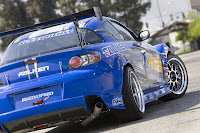
 Speed Machine Performance is a retailer and tuning house run by Dave Gibson and his team of knowledgeable techs, who boast a combined 30 years of experience working with rotary engines, most recently gaining notoriety in the Mazda drift community. The shop has had its hands on some fairly high-profile slide machines, like the FD generation RX-7s of the C-West/DRFT and Falken Tire teams, and in fact Falken Motorsports has retained Speed Machine’s services as mechanics and car makers. That’s why when it was time for Falken to look toward its drifting future, it went right to its valued constructor.
  SMP continued to look for power by completely overhauling the forced induction setup on the 13B, fashioning custom manifolds for the duo of Garrett GT28RS turbochargers. Twin Turbosmart 48mm Pro-gate wastegates allow exhaust to bypass the pumps’ turbine blades, and spent gases are sent to the atmosphere via a dual 3” aluminum exhaust. Meanwhile the compressor sections compel induction to a Blitz Nissan Skyline GT-R intercooler that’s been outfitted with SMP end tanks, a heat exchanger that is V mounted opposite a custom Speed Machine double-pass, dual-core radiator and FAL fan. Charge plumbing, rigged with Adel Wiggins clamps and a pair of Turbosmart race port blow-off valves, ultimately delivers boost to an SMP custom intake manifold with two 72mm BDL throttle bodies.


